Why your RBAC linter misses privilege escalation chains
Tools like kube-linter are good at catching the obvious stuff: wildcard verbs, cluster-admin bindings, excessive Secret access. But there’s a vulnerability class they fundamentally cannot detect: indirect privilege escalation through binding chains.
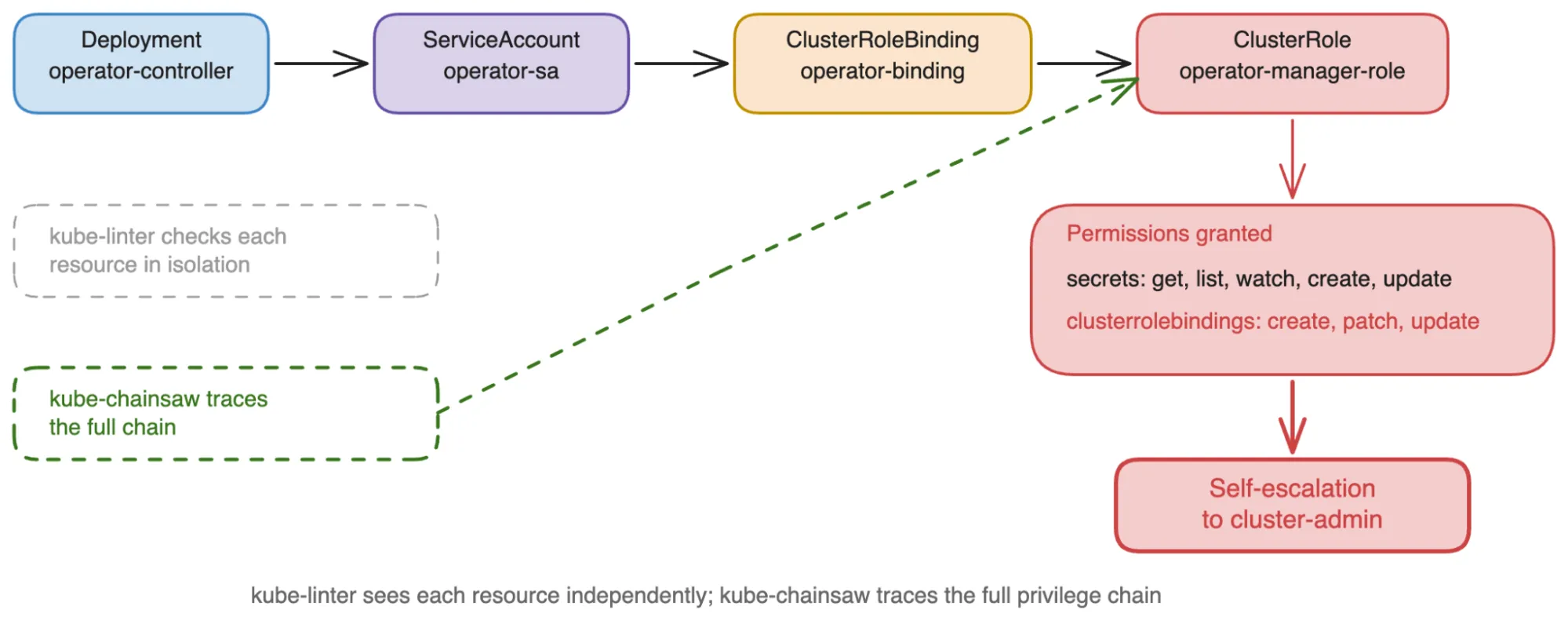
The problem is architectural. Per-object linters check each Kubernetes resource in isolation. They never correlate a Deployment’s ServiceAccount with the ClusterRoleBinding that grants it RBAC modification capabilities. The escalation path is invisible because it spans multiple manifests.
I built kube-chainsaw to fix this. It builds permission graphs from static manifests and traces privilege chains that per-object linters miss.
The blind spot
Consider a typical operator RBAC setup. Three manifests, nothing unusual:
# ClusterRole
apiVersion: rbac.authorization.k8s.io/v1
kind: ClusterRole
metadata:
  name: operator-manager-role
rules:
  - apiGroups: [""]
    resources: ["secrets"]
    verbs: ["get", "list", "watch", "create", "update"]
  - apiGroups: ["rbac.authorization.k8s.io"]
    resources: ["clusterrolebindings", "clusterroles"]
    verbs: ["create", "patch", "update"]
# ClusterRoleBinding
apiVersion: rbac.authorization.k8s.io/v1
kind: ClusterRoleBinding
metadata:
name: operator-binding
roleRef:
apiGroup: rbac.authorization.k8s.io
kind: ClusterRole
name: operator-manager-role
subjects:
- kind: ServiceAccount
name: operator-sa
namespace: operator-system# Deployment
apiVersion: apps/v1
kind: Deployment
metadata:
name: operator-controller
namespace: operator-system
spec:
selector:
matchLabels:
app: operator
template:
spec:
serviceAccountName: operator-sa
containers:
- name: manager
image: operator:latestNo wildcards. No cluster-admin binding. kube-linter reports nothing alarming. Maybe a note about Secret access, but nothing critical.
Now trace the chain manually. The Deployment uses operator-sa. That ServiceAccount is bound cluster-wide to operator-manager-role. That role can create and patch ClusterRoleBindings. The operator can therefore grant itself (or any ServiceAccount) cluster-admin at runtime. It also has read/write access to every Secret cluster-wide.
kube-linter cannot see this because it never builds the graph.
How an attacker exploits this
If an attacker compromises the operator pod (container escape, dependency vulnerability, supply chain attack), they inherit the ServiceAccount token automatically. Three commands to full cluster access:
# Step 1: verify permissions
kubectl auth can-i create clusterrolebindings
# yes

# Step 2: grant cluster-admin
kubectl create clusterrolebinding pwned-admin \
  --clusterrole=cluster-admin \
  --serviceaccount=operator-system:operator-sa

# Step 3: full cluster access
kubectl get secrets --all-namespaces -o json
No privilege escalation exploit needed. The RBAC configuration already provides the permissions. The operator was one ClusterRoleBinding away from full cluster-admin, and it had the ability to create that binding itself.
This pattern is common in controller-runtime operators. The controller needs create/patch on Roles and RoleBindings for legitimate reconciliation, but the manifests often also grant it on ClusterRoleBindings, usually from copy-pasted templates that were never scoped down.
The fix: graph traversal on static manifests
Detecting privilege escalation requires cross-object analysis. You need to see the Deployment, look up its ServiceAccount, find all bindings referencing that account, resolve the roles, and evaluate whether the resulting permission set enables escalation.
kube-chainsaw follows this approach:
- Parses all YAML manifests from a directory: ClusterRoles, Roles, bindings, ServiceAccounts, Pods, Deployments, DaemonSets, StatefulSets, Jobs, and CronJobs
- Builds a directed graph: workload → ServiceAccount → binding → role → verbs/resources
- Traverses the graph to detect 15 categories of privilege escalation and misconfiguration
- Adjusts severity based on binding scope: cluster-wide bindings are HIGH or CRITICAL, namespace-scoped are WARNING, unbound roles are INFO
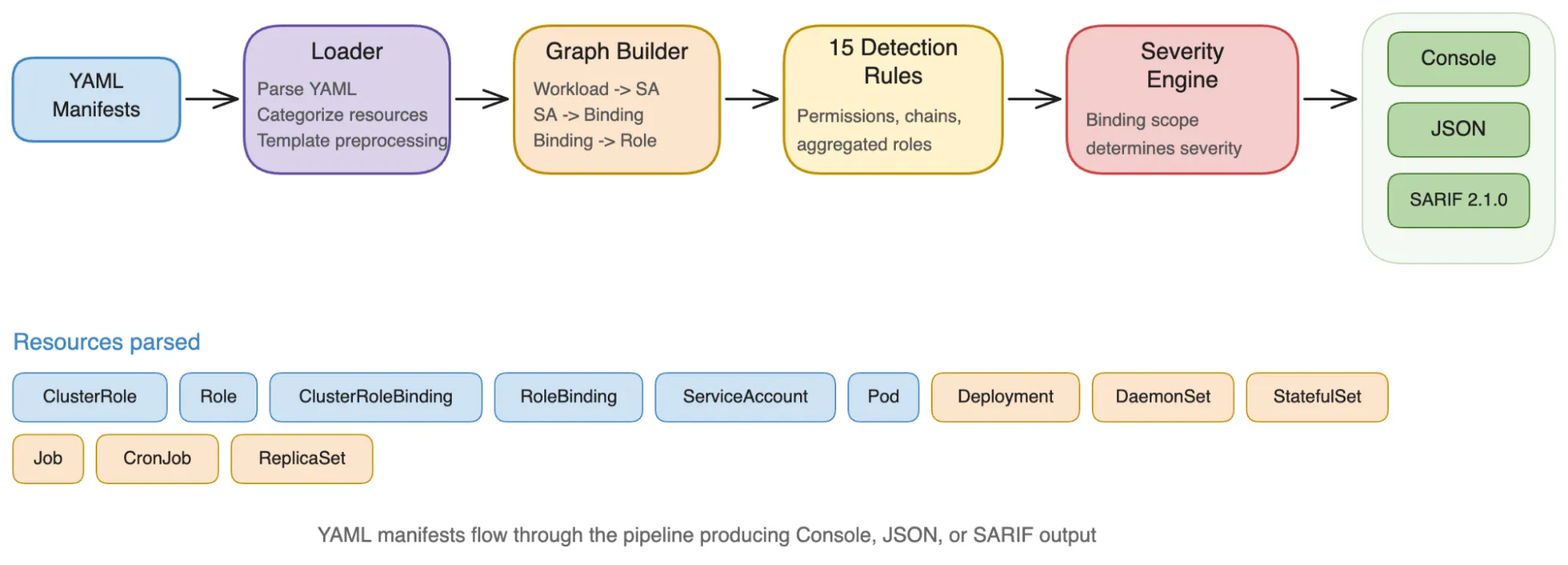
The severity model matters. The same ClusterRole produces different severity levels depending on how it’s bound:
| Binding type | Severity | Rationale |
|---|---|---|
| ClusterRoleBinding with wildcards | CRITICAL | Full cluster access |
| ClusterRoleBinding without wildcards | HIGH | Broad but scoped access |
| RoleBinding with wildcards | HIGH | Namespace-wide access |
| RoleBinding without wildcards | WARNING | Limited blast radius |
| No binding (unbound) | INFO | Dormant template |
No per-object linter can make this distinction. It requires correlating the role with its bindings.
Hands-on walkthrough
Install
go install github.com/ugiordan/kube-chainsaw/cmd/kube-chainsaw@latestBinaries are also available from the GitHub releases page. Docker and GitHub Action options are also available.
Scan your manifests
$ kube-chainsaw config/Output:
=== HIGH ===

  [KC-006] Secrets access
    File:        config/rbac/role.yaml
    Resource:    ClusterRole/operator-manager-role
    Description: Role "operator-manager-role" grants access to
                 dangerous resource "secrets"
    Remediation: Restrict Secrets access to specific namespaces
                 and only the verbs needed

  [KC-010] RBAC modification capability
    File:        config/rbac/role.yaml
    Resource:    ClusterRole/operator-manager-role
    Description: Role "operator-manager-role" grants access to
                 dangerous resource "clusterrolebindings"
    Remediation: Limit RBAC modification to dedicated admin Roles
                 with proper audit

  [KC-011] Privilege escalation via Role/Binding modification
    File:        config/rbac/role.yaml
    Resource:    ClusterRole/operator-manager-role
    Description: Role "operator-manager-role" can create/modify
                 Roles or Bindings
    Remediation: Restrict ability to create/modify Roles and
                 Bindings to admin users only

Total: 3 findings [3 HIGH]
Compare with kube-linter on the same manifests:
$ kube-linter lint config/
# Only flags: "binding to cluster role that has
#   [create get list patch update watch] access to [secrets]"
# Misses: RBAC modification, privilege escalation via
#   Bindings, workload creation risk
Generate SARIF for GitHub Code Scanning
$ kube-chainsaw config/ --output results.sarifThis produces a SARIF 2.1.0 file compatible with GitHub code scanning, GitLab SAST, or any SARIF-compatible platform.
Suppress accepted risks
For cases where a finding is a known, accepted risk (e.g., the operator genuinely needs cluster-wide Secret access for TLS certificate management):
# suppressions.yaml
suppressions:
  - rule_id: KC-006
    resource_name: operator-manager-role
    reason: "Operator manages TLS certificates stored as Secrets"
$ kube-chainsaw config/ --suppressions suppressions.yamlSuppressed findings still appear in output (marked as suppressed) for audit trail purposes but don’t affect the exit code.
CI integration
- uses: ugiordan/kube-chainsaw@v1
  with:
    paths: config/ deploy/
    fail-on: HIGH
    format: sarif
    output: results.sarif

- uses: github/codeql-action/upload-sarif@v3
  with:
    sarif_file: results.sarif
The workflow fails if any unsuppressed finding at HIGH or above is detected. SARIF results appear in the repository’s Security tab.
What gets detected
kube-chainsaw runs 15 detection rules organized in three categories:
Risky permissions on ClusterRoles and Roles: wildcard permissions (verbs: ["*"] or resources: ["*"]), dangerous verbs (escalate, impersonate, bind), sensitive resource access (Secrets, pods/exec, pods/attach, nodes, persistent volumes), and escalation combinations (create/patch/update on roles or bindings within the same rule).
Workload-to-cluster-admin privilege chains: traces the full path from a workload (Pod, Deployment, Job) through its ServiceAccount and bindings to the referenced role. Flags workloads whose ServiceAccount is bound to cluster-admin, and RoleBindings that reference a ClusterRole instead of a namespace-scoped Role (a common misconfiguration where a developer intends namespace-level access but references a ClusterRole).
Aggregated ClusterRole detection: detects ClusterRoles that use label selectors to dynamically combine permissions from other ClusterRoles. Because effective permissions depend on which ClusterRoles match the selector at runtime, they can’t be fully determined from static manifests alone.
All checks are apiGroup-aware, so a CRD named secrets in the custom.example.com group won’t trigger false positives.
kube-chainsaw vs. the field
| Tool | Static analysis | Graph traversal | Privilege chains | Workload analysis |
|---|---|---|---|---|
| kube-chainsaw | Yes | Yes | Yes | Yes |
| kube-linter | Yes | No | No | No |
| KubiScan | No (live cluster) | Yes | Yes | No |
| rbac-tool | No (live cluster) | Yes | No | No |
| kubectl-who-can | No (live cluster) | Yes | No | No |
kube-chainsaw is the only tool that performs static graph traversal on YAML manifests to detect privilege escalation chains before deployment, requiring no live cluster. The other graph-aware tools (KubiScan, rbac-tool, kubectl-who-can) all require a running cluster.
Best practices
-
Scope ClusterRoles to minimum required resources and verbs. If the operator only needs to read Secrets in its own namespace, use a local Role and RoleBinding instead of cluster-wide resources.
-
Never grant create/patch/update on ClusterRoleBindings unless absolutely required. This is the most dangerous permission an operator can have. It enables self-escalation to
cluster-admin. -
Use RoleBindings instead of ClusterRoleBindings when possible. A RoleBinding referencing a ClusterRole limits scope to a single namespace, reducing blast radius.
-
Run kube-chainsaw alongside kube-linter in CI. They’re complementary: kube-linter covers CIS benchmarks, resource limits, SecurityContext, and container best practices. kube-chainsaw focuses on RBAC privilege chain analysis.
-
Suppress findings with documented reasons. Every suppression should include a
reasonfield explaining why the risk is accepted, creating an audit trail.
Per-object linting catches the obvious problems. Graph-level analysis catches the ones that actually get exploited. Run both.
Also published on Red Hat Developer.